

How the tobacco industry stays rich while farmers remain poor
by Rozene Adremesin
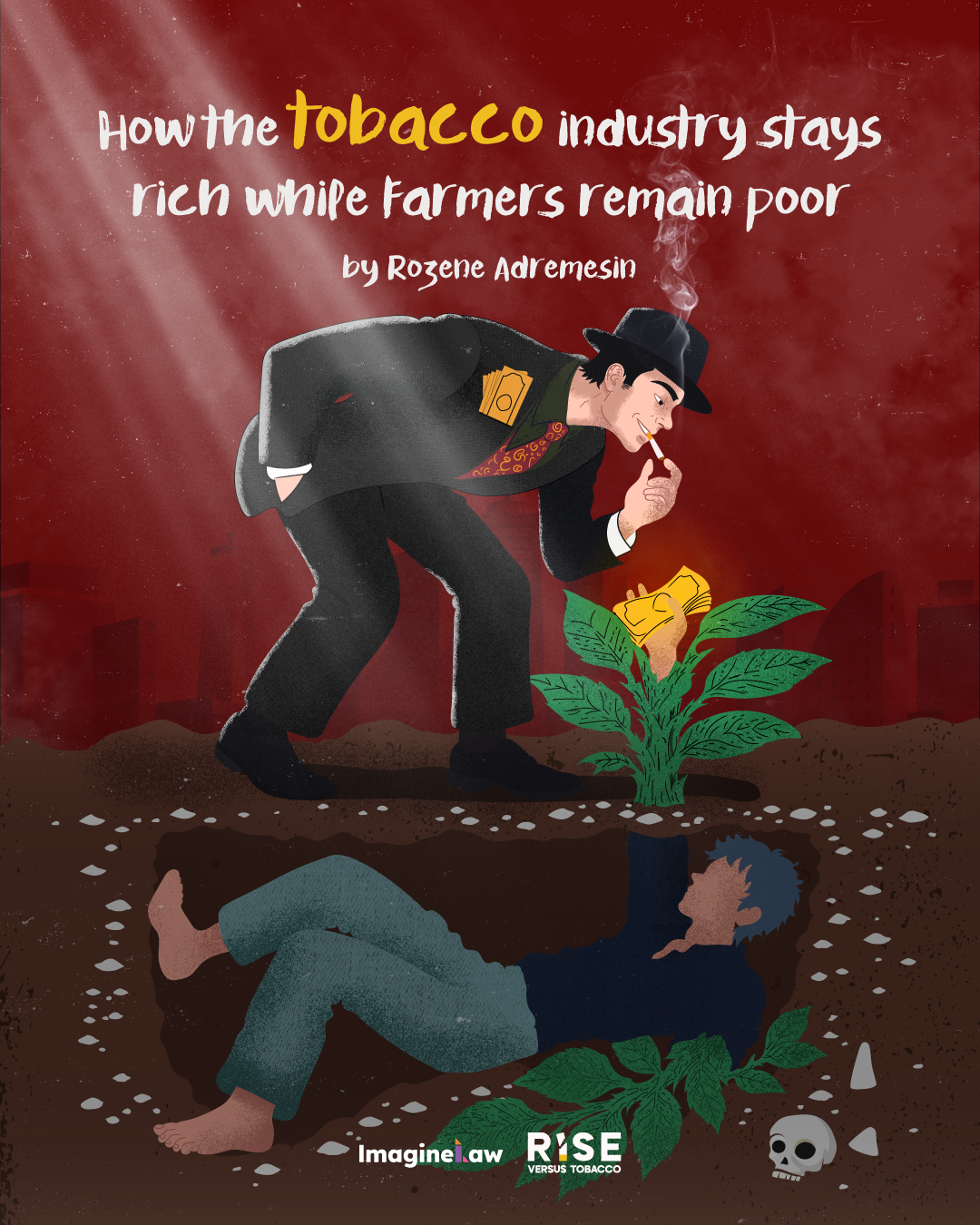
Under modern consumerism, it is so easy to disconnect a product, service, or good from the toil required to create it. Every item purchased is often stripped of its inherent humanistic quality and reduced to a commodity. Take the recent surge in popularity of ube, a purple yam endemic to the Philippines. As this crop becomes a key ingredient in mainstream markets globally, the struggles faced by Filipino farmers who cultivate and produce it remain largely unseen. Inadvertently, we sustain the system that exploits these farmers, without realizing that they receive underwhelming wages disproportionate to their product’s overwhelming demand.
This phenomenon is captured by the term “commodity fetishism”. Commodity fetishism demonstrates how capitalism has systemically blinded us to the human labor behind every commodity. Where human labor and agency are made invisible, a breeding ground is formed for exploitation to thrive. And this is quintessentially how big and high-risk industries such as the tobacco industry amass profit and sustain their power on the backs of the farmers and at the expense of public health.
Cigarettes and other tobacco products are fetishized by the industry by imbuing them with a false sense of social status, sexual allure, or empowerment—all of which are glamorous facades to mask their inherent health risks. This predatory marketing has evolved to target a new generation of smokers by manufacturing their products with child-friendly flavors and appealing packaging. Yet, the harm extends far beyond the consumer. Beyond the deleterious effects from their consumption, it also maintains the capitalist project of the tobacco industry.
Behind every cigarette stick lies a grim reality of farmers trapped in debt, workers exposed to toxic conditions, and communities burdened by diseases caused by these products. By erasing the human cost of labor and according harm, the industry sustains the illusion of value, and that illusion is the lifeblood of exploitation and the enemy of reform.
A government-backed system of control
In the Philippines, tobacco farming is portrayed as a lifeline and profitable venture for farmers and a pillar of national economic prosperity. The government reinforces this dependence and bolsters the interests of the tobacco companies through Republic Act 7171.
Through this law, the State extends special support to the farmers of Virginia tobacco-producing provinces, predominantly in the northern provinces of Luzon such as Ilocos Norte, Ilocos Sur, Abra, and La Union, through a dedicated financial redistribution mechanism that links local government funding directly to tobacco production volume. Many mistakenly perceive this law as a beacon of hope for livelihood, a source of economic prosperity, and a catalyst for community development.
While the law mentions the prospect of alternative farming systems in its provisions, its actual framework is heavily skewed toward tobacco production, leaving almost no room for crop diversification. Say a farmer wants to switch their production to rice, corn, or garlic. Eventually, they will find that the systems and support in place are all optimized for tobacco farming: cash loans, equipment and irrigations systems, training and capacity building, and market facilitation. The industry, through this law, ensures that the path of least resistance always leads back to the tobacco leaf. This is institutionalized by the National Tobacco Administration (NTA), an attached agency of the Department of Agriculture (DA), which vows and arranges a guaranteed market to tobacco farmers. It makes tobacco appear like the only viable choice while actively undermining the viability of other crop alternatives.
Some farmers explain that they cannot abandon tobacco farming because it remains more lucrative than any alternative as it offers higher gross returns, while planting alternative crops like local watermelon or corn might yield a relatively meager income. Many local governments maintain a similar stance, because they view the tobacco industry more as a strategic partner in development and less of a regulated entity. This makes it challenging for LGUs to implement and enforce stringent tobacco control regulations, as economic gains overshadow public health concerns.
Another way that tobacco companies keep farmers in their tight grip is through contract farming. Under this system, farmers are contracted by transnational tobacco companies to grow tobacco under predatory obligations that most of the time leave the farmers with little wiggle room for negotiation. Many tobacco farmers report receiving far less than stated floor prices for high-grade tobacco leaves, and struggle to receive fair trading prices. The price disparity is due to practices that allow buyers to routinely undervalue the tobacco leaves produced.
Aside from that, tobacco companies advance seeds, fertilizers, and other equipment at the start of the contract and deduct the inflated costs from the farmers’ payments later on. Consequently, farmers find themselves in a challenging position, as tobacco farming is both labor-intensive and financially burdensome, while the prospect of ceasing tobacco farming altogether could leave them entrenched in debt.
Development of underdevelopment
This pattern of exploitation unfolds disproportionately across the Global South, where agriculture is the backbone of survival for many communities. The Philippines is one of the top 50 tobacco-growing economies, along with low- to middle-income countries (LMICs) such as Malawi, Indonesia, and Zimbabwe. Meanwhile, in a market-capitalization ranking of the biggest publicly listed tobacco corporations worldwide, the top three tobacco brands are owned by companies from the United States and the United Kingdom. Both countries maintain imperialistic and hegemonic control over the global means of production, while the burden of tobacco production falls on agricultural nations shackled by semi-feudal conditions.
Multinational corporations of the Global North are highly dependent on developing countries of the Global South to extract profit, a world-systems dynamic that also illustrates how the Global North shapes and perpetuates the exploitation of the people in the Global South. This exploitation is carried out by monopolizing raw materials and enforcing cheap labor, ensuring that wealth is accumulated and concentrated in the hands of a small elite in the Global North. Extractive industries, such as large-scale mining in Sub-Saharan Africa, oil extraction in Latin America, and the fast-fashion industry that sustains itself on child labor, effectively weaponize this machinery for their own gain. Ultimately, the tobacco industry does the same, and has also created deceptive narratives to shield itself from accountability.
In Malawi, farmers report that the predatory loans offered by British American Tobacco and Imperial Brands are often mandatory, trapping them in inescapable cycles of debt, even as a landmark lawsuit filed against these companies alleged complicity in forced labor, child labor, and hazardous working conditions. Globally, farmers are led to believe that tobacco, unlike alternative crops, is the only product with a guaranteed buyer. This misleading narrative and forced dependency not only ensure that farmers remain tethered to the tobacco crop but also perpetuates their poverty to fuel corporate vested interests.
Escaping the tobacco trap
The tobacco industry has long exhausted its moral ground by preying on the most vulnerable. And backed by our local bureaucrat capitalists, they continue to exploit local labor by transforming farmers into cash cows to sustain their mercenary interests. These conditions create a capitalistic microcosm in the Philippines in the hands of the tobacco industry, where the industry fattens itself through the exploitation of Filipino farmers.
Breaking free from tobacco dependence demands structural change. Policymakers bear the greatest burden in dismantling the chains that keep farmers trapped in this predatory system. The government must end subsidies that sustain tobacco cultivation and redirect support toward food crops that nourish communities. This will allow farmers to access fair financing for alternative livelihoods and free them from exploitative contracts created by the industry.
Crucially, the government must implement aggressive tax hikes to internalize the true health, economic, and environmental costs of tobacco use. Tobacco tax revenues can be earmarked to protect public health and provide the State with the financial leverage to completely shift tobacco farmers away from tobacco farming and into sustainable, life-giving food economies.
To confront tobacco capitalism is to stand with the farmers, whose labor sustains an industry built on their own suffering, by exposing the false narratives and promises that keep them in a vicious cycle of poverty. As we observe World No Tobacco Day, we must look past tobacco as a fetishized commodity and see the human struggle hidden behind the smoke. The struggle of tobacco farmers is a labor issue, a human rights issue, and a socialist reckoning. We must demand a transition that offers farmers dignity, freedom from debt, and a harvest that sustains life rather than one that leads them to a tragic end.
***
Rozene Adremesin is a research associate for ImagineLaw, a public interest organization working on evidence-based policy solutions to enable people to lead healthy and meaningful lives. The views on this article are her own.