

Vapewashed: Who’s gaslighting the next generation into smoking?
by Gerald John Guillermo
I grew up in a household where smoking was normal. I used to buy cigarette packs for my father at the neighborhood store. The grotesque image of a body ravaged by tobacco posted in rural health centers where my mother worked left an indelible imprint that made the dangers of smoking undeniable to me. But some children in our barangay still ended up smoking even though I refused to.
Yet, I witnessed how eventually fewer and fewer children smoked. Thanks to decades of public health campaigns, higher taxes, advocacy, and advertising bans, smoking has been less desirable and less accessible, especially to young people. In the Philippines, the iconic “Yosi Kadiri” campaign of the 1990s helped turn smoking into something socially unacceptable, using humor and public education to drive home the harms of tobacco.
But while cigarettes have faded from view, the industry behind them has resurfaced, with its products rebranded and repackaged. Sleek vapes with candy flavors and gadget-like designs are now marketed not as harmful, addictive products but as symbols of freedom, creativity, and self-expression.
Gaslighting the youth
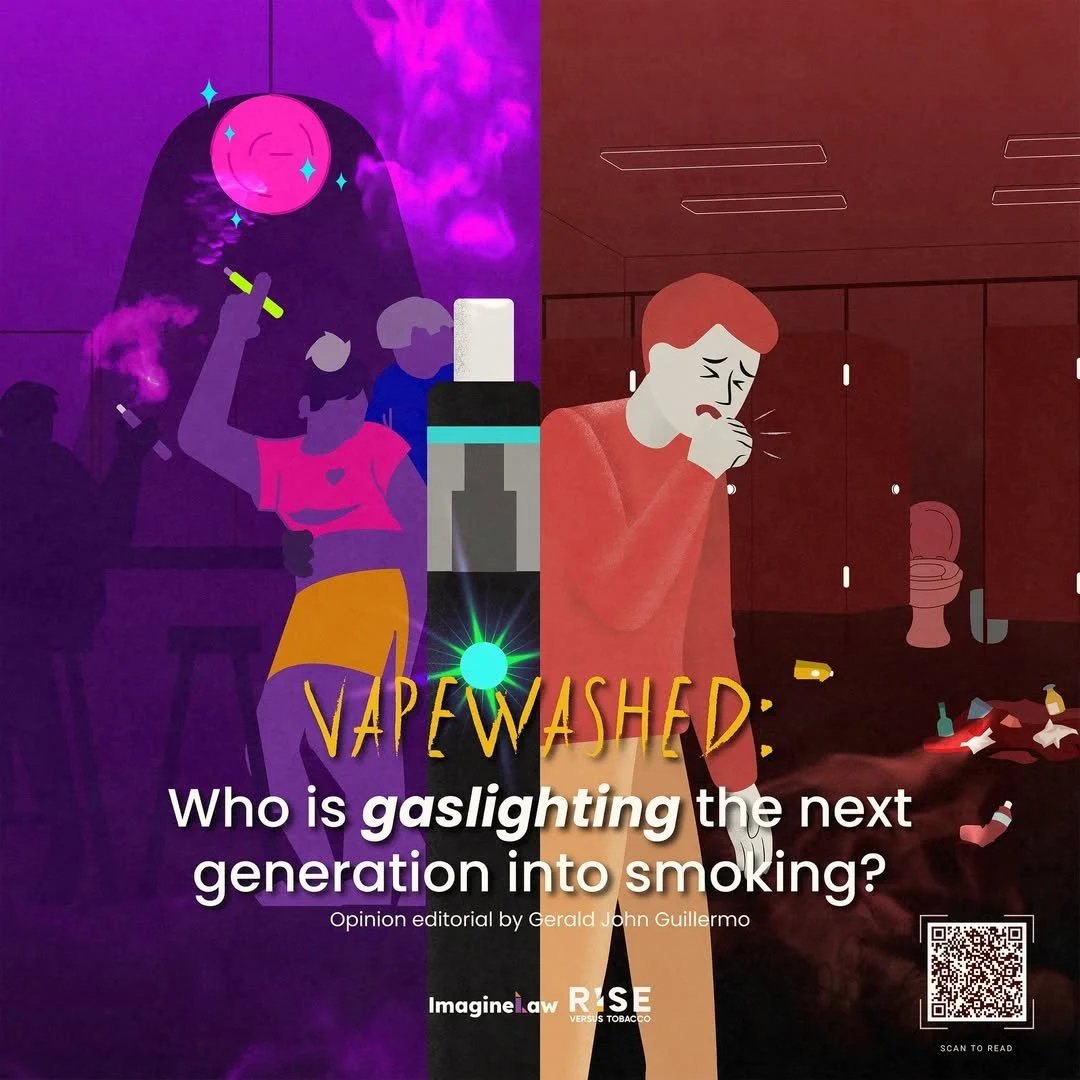
Young people are being “vapewashed”—that is, they are being convinced that vaping is harmless, stylish, even liberating. At its core, however, “vapewashing” is the rebranding of addiction as identity. The term borrows from “greenwashing,” where corporations use deceptive marketing to appear socially responsible while continuing harmful practices.
In the same way, by “vapewashing,” the tobacco industry has repackaged its old business model in the language of innovation and wellness. It speaks of a “smoke-free future” while flooding the market with flavored vapes and heated tobacco products that appeal directly to the youth.
The manipulation is subtle but powerful. By positioning vaping as a choice, a symbol of independence and self-expression, the industry convinces young people that they are rejecting the old norms of smoking, when in reality, they are embracing the same addiction in a new form. What is sold as rebellion is, in truth, submission to one of the most sophisticated and manipulative marketing machines in history.
What makes this deception more dangerous is that it has been enabled by government complicity. In the Philippines, tobacco companies are now regular fixtures in public spaces under the guise of “innovation” and “sustainability.” At Lab4All events, for example, Philip Morris - Fortune Tobacco Corporation is given a platform to promote its so-called “smoke-free future,” even while continuing to profit from cigarette sales.
The passage of a weak vape law, Republic Act No. 11900, further legitimized this narrative by transferring regulatory authority from the Department of Health to the Department of Trade and Industry, framing vaping not as a public health threat, but as a consumer issue. The result is a regulatory environment that favors industry growth over public protection, giving tobacco companies space to reinvent themselves as part of the health solution rather than the source of the problem.
“Harm reduction” or harm seduction?
The same companies that once denied the dangers of smoking have rebranded their business as part of a “health-conscious” future. Corporations like Altria, the parent company of Philip Morris, have invested in e-cigarette companies such as Juul Labs and now market vapes and heated tobacco products as “harm reduction tools” and the “future of smoking.” The pitch is simple: vaping is supposedly a cleaner, safer alternative to cigarettes—an option for smokers looking to quit.
But if vaping were truly about harm reduction, we would see it primarily among adult smokers trying to quit. Instead, data show the opposite trend. Globally, and in the Philippines, vaping has risen fastest among teenagers who never smoked in the first place. The Global Youth Tobacco Survey found that one in four Filipino adolescents has already tried e-cigarettes. Flavored products like mango, cotton candy, and strawberry milk are designed not for hardened smokers but to lure curious youth. These products may contain nicotine, along with dozens of toxic chemicals that damage the lungs and cardiovascular system.
Moreover, hundreds of EVALI or lung injury cases linked to vaping and the first recorded vape-related death in the Philippines show that vaping is still harmful. As data comes in, what we see clearly is that these ‘novel’ products have seduced generations who would never have smoked into a new, profitable, but still deadly addiction.
A mixed response
Some governments have acted decisively by banning flavored vapes or tightening advertising rules. In Southeast Asia, five out of 10 nations have banned vapes and e-cigarettes, with Singapore, as one of the earliest countries to ban vaping in 2018, having now released tougher penalties for vaping. Others are still catching up to an industry that adapts faster than regulation.
But enforcement has been inconsistent. Republic Act No. 11900 was meant to create a framework for regulating vapes and novel tobacco products. Instead, it has been widely criticized by doctors and tobacco control advocates for weakening existing protections, particularly by transferring regulatory authority from the health sector to the DTI, a move seen as prioritizing commerce over public health. In practice, brands continue to collaborate with celebrities and influencers, such as DJ Steve Aoki, Helm restaurant chef Joshua Boutwood, and “Zynfluencers”, despite clear legal prohibitions. Health warnings are often absent from vapes, stripping consumers of their right to accurate information about the risks of nicotine addiction and chemical exposure when vaping. Meanwhile, age verification is weak, and online sales continue unchecked. With just a few taps, a 16-year-old can order a flavored vape and have it delivered straight to their door, no ID required.
Breaking the cycle
Parents, educators, policymakers, and young people themselves need to recognize vapewashing for what it is: an attempt to lure new customers into a deadly addiction. Laws must be enforced strictly, especially those banning celebrity endorsements and youth-targeted advertising. Loopholes in online sales and flavor regulation must be closed. More importantly, the government must cut ties with this deadly industry, instead of offering it a platform.
At the same time, counter-marketing campaigns should expose vapewashing for what it truly is: the repackaging of addiction. Youth-led movements like “TobaccOFF NOW!”, launched this year, are critical in pushing back against vape normalization, challenging manipulative tactics, and demanding accountability. Currently, the movement is doing youth caravans all over the country to mobilize young Filipinos against tobacco industry interference.
During Lung Cancer Awareness Month this November, let us listen to our bodies. The first time smoke or vapor enters the lungs, the body tries to expel it. That instinct is a reminder that it does not belong there. Let us listen to what our bodies already tell us. Addiction is not autonomy, but rather a loss of it, masked as choice. Vapewashing is teaching young people to see submission as freedom. We must ensure they see through the smoke and mirrors.
***
Gerald John Guillermo is lawyer and policy associate at ImagineLaw. The views on this article are his own.